Jeju Air Flight 2216: Bird Strike, Gear-Up Landing and the Muan Airport Crash
Jeju Air Flight 2216 crashed at Muan Airport after a bird strike affected both engines during an emergency approach. This technical analysis examines bird ingestion, engine damage, aircraft performance, the gear-up landing, runway overrun and airport infrastructure.
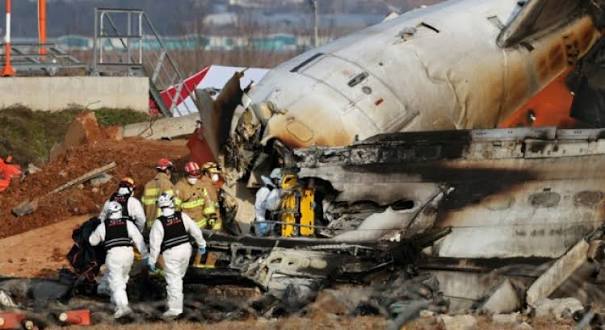
Beyond the Bird Strike: A Technical Analysis of Jeju Air Flight 2216
Introduction
On December 29, 2024, Jeju Air Flight 2216, a Boeing 737-800 operating from Bangkok to Muan International Airport in South Korea, became one of the most serious aviation accidents of the decade.
The aircraft, registered as HL8088, was carrying 181 people: 175 passengers and six crew members. During its approach to Muan, the crew encountered bird activity and subsequently declared an emergency. The aircraft eventually performed a gear-up landing, overran the runway and collided with a structure near the runway end.
Only two people survived. The accident killed 179 occupants.
At first glance, the accident appeared to present a relatively straightforward chain:
bird strike → engine problems → landing gear problem → runway overrun → collision.
However, aviation accidents are rarely that simple.
Flight 2216 is particularly important because the sequence involves several interconnected technical and operational questions:
- What exactly happened to the engines after the bird encounter?
- Why was a gear-up landing performed?
- Why did the aircraft land so far along the runway?
- How much runway remained after touchdown?
- What role did aircraft energy management play?
- Why did the aircraft's recording systems stop before the crash?
- How did the runway-end infrastructure affect survivability?
- Could the outcome have been different if the aircraft had encountered a frangible structure instead?
The investigation remains unresolved, and therefore these questions must be examined without treating any single factor as the definitive cause.
The available evidence instead points toward a systems-level accident involving aircraft, crew, airport infrastructure, emergency procedures and the surrounding safety environment.
1. The Aircraft
Jeju Air Flight 2216 was operated by a Boeing 737-800 registered as HL8088.
The Boeing 737-800 is a conventional twin-engine narrow-body transport aircraft powered by two CFM56-7B turbofan engines.
The aircraft is designed to remain controllable following the loss of one engine.
That is a fundamental requirement for transport-category aircraft.
However, an aircraft experiencing severe problems affecting both engines during the approach is operating under a dramatically different set of constraints.
The distinction between engine failure, loss of thrust, and complete electrical or hydraulic consequences is particularly important.
An engine may suffer substantial damage while still producing some thrust.
Conversely, shutting down an engine that is damaged but still producing useful thrust can change the aircraft's remaining performance and system availability.
This is why the precise sequence of engine events in Flight 2216 is one of the most important elements of the investigation.
2. The Bird Encounter
The aircraft was approaching Muan International Airport when the crew received a warning concerning bird activity.
The preliminary investigation indicates that the aircraft encountered birds during the approach/go-around sequence and subsequently declared an emergency.
The investigation found evidence of bird strikes affecting both engines.
Bird ingestion is not automatically catastrophic.
Modern turbofan engines are designed and certified to withstand specified levels of foreign-object ingestion.
The problem is that certification is based on defined scenarios.
Large birds can cause:
- fan blade damage,
- compressor damage,
- airflow disruption,
- engine vibration,
- compressor instability,
- combustion disturbances,
- thrust reduction,
- and, in severe cases, engine shutdown.
The severity depends on factors such as:
- bird mass,
- number of birds,
- impact location,
- engine operating condition,
- rotational speed,
- and whether the bird material penetrates deeper into the engine core.
Flight 2216 is therefore not simply a "bird strike accident."
The technically relevant question is:
What did the bird encounter do to the propulsion system, and what aircraft systems were subsequently affected?
3. Engine Failure and Aircraft Energy
One of the most important concepts in understanding Flight 2216 is energy management.
An aircraft approaching a runway possesses kinetic and potential energy.
Kinetic energy is primarily related to airspeed.
Potential energy is primarily related to altitude.
During a normal approach, the pilot can manage the aircraft's energy using:
- pitch,
- configuration,
- drag,
- and engine thrust.
Thrust is particularly important because it allows the crew to add energy when required.
A severely degraded propulsion condition removes part of this control mechanism.
The crew must then rely much more heavily on aircraft attitude, speed and configuration.
This becomes especially critical during a gear-up landing.
4. Why a Gear-Up Landing Changes the Problem
A conventional Boeing 737 landing involves several stages:
- approach,
- landing gear extension,
- flap configuration,
- speed reduction,
- flare,
- touchdown,
- braking,
- reverse thrust,
- runway deceleration.
Flight 2216 did not follow the conventional sequence.
The aircraft landed without its landing gear deployed.
This meant that the fuselage became the primary contact surface with the runway.
That immediately changes the aircraft's deceleration characteristics.
The aircraft loses the normal contribution of:
- wheel braking,
- tire-runway friction,
- nose-wheel steering,
- and reverse-thrust-supported deceleration.
Although the engines can provide reverse thrust in a normal landing, the exact availability of thrust after a severe engine event is a separate question.
The aircraft therefore entered a situation where runway length and touchdown position became critical survival variables.
5. Touchdown Location and Remaining Runway
One of the most significant findings in the NTSB's 2024 annual report is that Flight 2216 landed well beyond the touchdown zone and without its landing gear deployed.
This is technically important.
A runway is not simply a fixed distance.
It is a limited energy-absorption system.
The aircraft arrives with a certain amount of kinetic energy:
E = ½mv²
where:
- E = kinetic energy,
- m = aircraft mass,
- v = aircraft velocity.
The relationship is particularly important because velocity is squared.
If speed increases, kinetic energy increases disproportionately.
That means reducing speed before touchdown is extremely valuable.
But reducing speed also requires altitude and time.
The crew therefore faces a fundamental trade-off:
maintain enough speed to remain safely airborne
versus
reduce speed enough to minimize touchdown energy.
This is one of the central aerodynamic challenges of any emergency landing.
6. The Runway Overrun
Once Flight 2216 touched down, the aircraft had limited remaining runway.
The aircraft continued forward and eventually departed the paved surface.
At that point, the accident transitioned from an aviation performance problem into an airport survivability problem.
This distinction is extremely important.
Even if an aircraft overruns a runway, the consequences do not have to be catastrophic.
Runway safety areas, engineered arresting systems, graded surfaces and frangible structures exist precisely because runway excursions can occur.
The final outcome depends not only on the aircraft's condition but also on what the aircraft encounters after leaving the runway.
7. The Localizer Structure
One of the most controversial technical issues surrounding Flight 2216 is the structure located near the runway end.
The structure supported equipment associated with the airport's Instrument Landing System, including the localizer.
A localizer provides lateral guidance to aircraft approaching a runway.
The technical question is not whether a localizer is necessary.
It is.
The question is how such equipment should be installed within an area where an aircraft could potentially leave the runway.
Airport navigation equipment located near runway ends is generally expected to be designed or mounted in a way that minimizes the hazard to aircraft during an excursion.
This is where the concept of frangibility becomes important.
A frangible structure is designed to break, collapse or yield under a specified aircraft impact rather than behaving like a rigid obstacle.
The purpose is simple:
The navigation system should not become a major source of structural damage during a runway excursion.
Current investigations and later official scrutiny have focused heavily on whether the Muan structure complied with applicable requirements and whether its design contributed to the severity of the crash.
8. Aircraft Versus Infrastructure
This leads to one of the most important questions in the entire accident:
Was the aircraft already in an unsurvivable condition before it reached the runway end, or did the runway-end environment transform a survivable emergency into a catastrophic accident?
That distinction matters.
A gear-up landing is dangerous.
A runway overrun is dangerous.
But neither automatically means that everyone aboard must die.
The aircraft's interaction with the final obstacle therefore deserves significant attention.
In January 2026, South Korean authorities acknowledged serious concerns surrounding the concrete mound/structure. Later reporting also described simulations suggesting that a different runway-end configuration could have produced a substantially different outcome. These findings remain part of an evolving investigation rather than a final determination of causation.
9. The Black Boxes and the Missing Final Minutes
Another unusual aspect of Flight 2216 was the loss of recording data.
The aircraft's Cockpit Voice Recorder and Flight Data Recorder stopped recording approximately four minutes before the crash.
This is highly significant.
Modern accident investigation depends heavily on:
- flight parameters,
- engine data,
- control inputs,
- radio communication,
- cockpit conversation,
- aircraft configuration,
- and system status.
When the final minutes of this data are missing, investigators must reconstruct the sequence using other evidence.
That evidence can include:
- radar data,
- ATC recordings,
- airport surveillance video,
- eyewitness accounts,
- wreckage examination,
- engine analysis,
- electrical-system analysis,
- flight-path reconstruction,
- and surviving portions of the recorded data.
The missing data therefore makes an already complex accident significantly harder to reconstruct.
10. Human Factors and Decision-Making
It is tempting after an accident to ask:
"What did the pilots do wrong?"
That question is often too simplistic.
Pilots in an emergency operate under:
- limited time,
- incomplete information,
- alarms,
- high workload,
- rapidly changing aircraft performance,
- and imperfect knowledge of the aircraft's exact condition.
Human factors research recognizes that decisions made under such circumstances cannot be evaluated in the same way as decisions made with unlimited time and complete information.
Flight 2216 is therefore a useful case study in:
decision-making under uncertainty.
The crew had to determine:
- whether the aircraft could continue,
- whether the landing gear was available,
- how much runway remained,
- how much propulsion was available,
- what runway to use,
- and how to configure the aircraft.
Every decision affected the next decision.
11. The Landing Gear Question
A conventional landing gear system provides several critical functions.
It:
- supports the aircraft,
- absorbs landing loads,
- provides braking,
- allows steering,
- and keeps the fuselage away from the runway.
Without the landing gear, the aircraft loses these capabilities.
The fact that Flight 2216 ultimately performed a gear-up landing therefore represents a major change in the accident dynamics.
However, the reason the landing gear was not deployed is one of the areas that must be treated carefully.
It would be premature to conclude that a single mechanical failure, pilot error or engine failure alone explains the configuration.
The interaction between propulsion, electrical power, hydraulic systems, cockpit workload and emergency procedures needs to be understood as a system.
12. Why the Accident Cannot Be Reduced to "Pilot Error"
Early reporting and leaked/interim findings have generated debate over whether the crew may have shut down the less-damaged engine.
That issue has been politically and emotionally controversial because it could imply that pilot actions contributed to the loss of available thrust.
However, reports based on interim findings should not automatically be treated as the final causal conclusion.
As of September 2026, South Korean authorities have not announced a definitive final cause of the accident. Recent reporting also indicates continuing investigations into airport infrastructure and government officials involved with localizer installation documentation.
This distinction matters for aviation safety.
The objective of an accident investigation is not simply to identify an individual who made an error.
It is to determine why that error became possible and why the system did not prevent it from becoming catastrophic.
13. The Swiss-Cheese Model of Aviation Safety
Flight 2216 can be examined through the "Swiss-cheese" model of accident causation.
Multiple safety layers normally exist:
Layer 1 — Aircraft design
Engine certification, flight controls, landing gear, electrical systems and structural protection.
Layer 2 — Crew training
Emergency procedures, engine failures, abnormal configurations and decision-making.
Layer 3 — Air traffic control
Information, runway assignment and emergency coordination.
Layer 4 — Airport infrastructure
Runway length, safety areas, navigation equipment and obstacle protection.
Layer 5 — Emergency response
Firefighting, rescue and medical response.
An accident becomes catastrophic when several holes in these layers align.
That is a much more useful way to examine Flight 2216 than asking which single component "caused" the crash.
14. What the Accident Teaches About Runway Safety
Runway safety is often discussed in terms of preventing aircraft from leaving the runway.
But prevention is only one part of the system.
A robust runway safety strategy must also assume that an excursion will occasionally occur.
This means designing the area beyond the runway so that:
if the aircraft leaves the runway, the environment does not unnecessarily destroy it.
This principle is particularly important for:
- runway end safety areas,
- airport perimeter structures,
- navigation equipment,
- approach lighting,
- localizer installations,
- terrain,
- and drainage structures.
Flight 2216 demonstrates why runway safety cannot be separated from airport infrastructure design.
15. Survivability Versus Accident Prevention
One of the most important concepts in modern aviation safety is the distinction between:
accident prevention
and
accident survivability.
Prevention attempts to stop the accident from occurring.
Survivability assumes that something has already gone wrong and asks:
Can the aircraft and its occupants survive the remaining sequence?
Flight 2216 appears to have passed through several stages:
- abnormal aircraft condition,
- emergency approach,
- gear-up landing,
- runway overrun,
- collision with a fixed structure,
- fire,
- catastrophic loss of life.
Every stage represents another opportunity for the safety system to reduce the severity of the outcome.
16. Why Flight 2216 Matters for Aviation Engineering
The accident has implications far beyond Jeju Air.
It raises questions about:
- bird-strike risk management,
- engine failure procedures,
- emergency landing-gear procedures,
- aircraft electrical architecture,
- cockpit workload,
- black-box power supply,
- runway-end safety,
- navigation equipment installation,
- frangible structures,
- airport certification,
- and emergency response.
The accident therefore belongs to a broader category of systems engineering failures, where multiple independent elements interact in unexpected ways.
17. The Most Important Question
Perhaps the most important question raised by Flight 2216 is not:
"What caused the crash?"
It is:
"Why did the emergency become catastrophic?"
Those are different questions.
The aircraft encountered a serious abnormal condition.
The crew attempted an emergency landing.
The aircraft reached the runway.
Then the runway excursion occurred.
Finally, the aircraft encountered a rigid structure.
At each stage, the system had a chance to reduce the severity of the outcome.
The investigation must therefore examine the entire chain.
Conclusion
Jeju Air Flight 2216 should not be remembered simply as a bird-strike accident.
It was a complex aviation safety event involving propulsion, aircraft configuration, energy management, human factors, runway performance, airport infrastructure and emergency survivability.
The preliminary investigation established that the Boeing 737-800 encountered bird activity and that both engines showed evidence of bird strikes. The aircraft subsequently landed without its landing gear deployed, overran the runway and collided with a structure near the runway end.
But those facts alone do not explain why the accident became so deadly.
The missing final minutes of recorder data, questions surrounding engine condition and shutdown decisions, the aircraft's landing configuration, the touchdown location and the design of the runway-end infrastructure all remain important pieces of the puzzle.
The most important aviation-safety lesson is therefore broader than any single failure.
An aircraft accident is often the final result of multiple interacting systems rather than one isolated mistake.
Flight 2216 demonstrates why modern aviation safety must consider not only how to prevent an aircraft from entering an emergency, but also how to ensure that when an emergency occurs, the aircraft has the greatest possible chance of remaining controllable—and that the environment beyond the runway does not turn a survivable event into a fatal one.
Until the investigation is formally concluded, Flight 2216 should therefore be viewed not as a solved accident, but as an evolving case study in aircraft systems, human factors, runway safety and airport engineering.